


Sunflowers from the Achterhoek
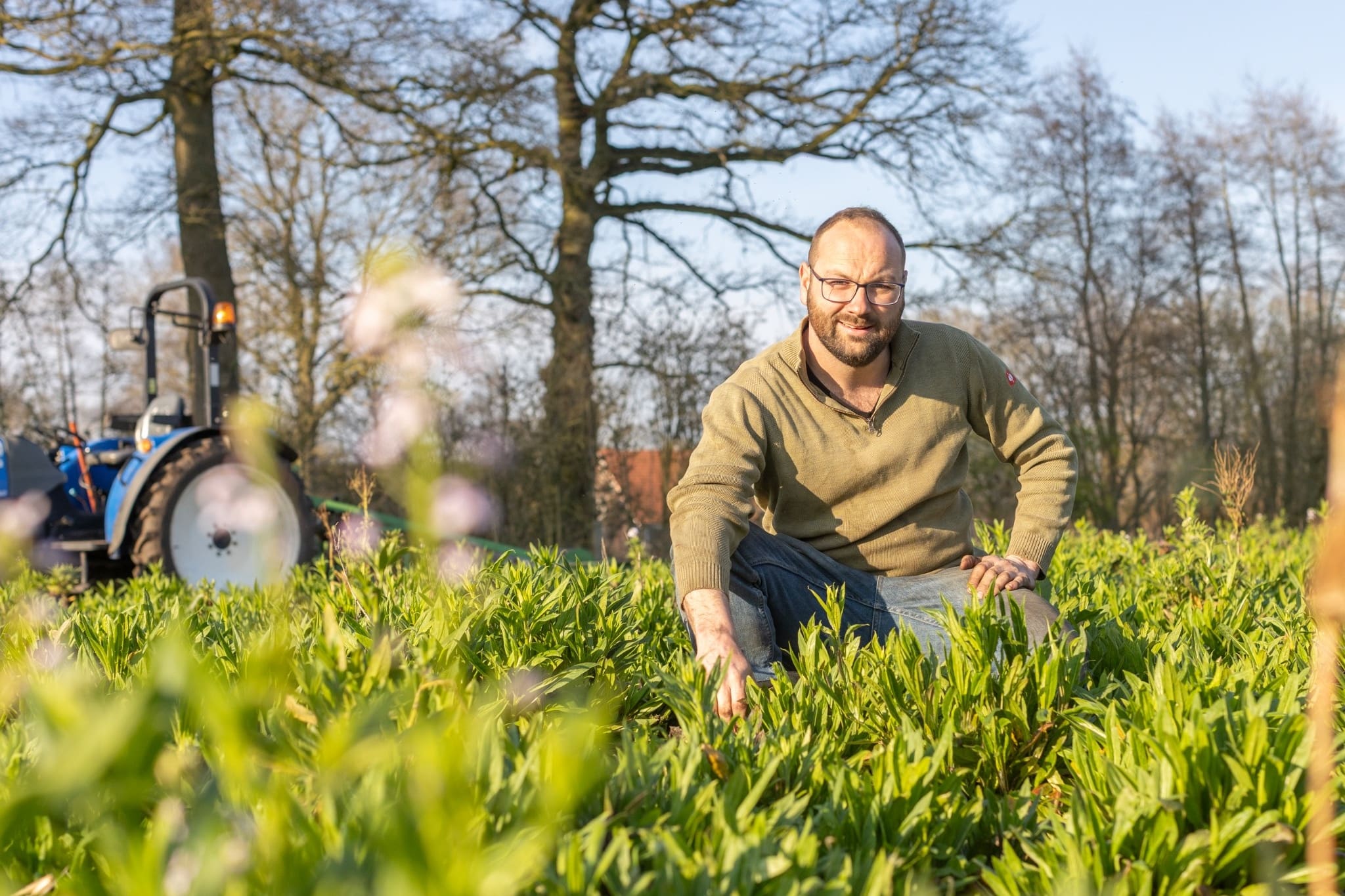
In 2019, Niek and Elze Sloetjes started their nursery 't Sonnevier. What began small and romantically has grown into a professional business with 15 hectares of summer flowers.
Sonnevier is Old Dutch for ‘flames of the sun’. From June until the end of October, a yellow glow of Sunrich Orange sunflowers stretches across 4 hectares of sandy soil. On adjacent plots, dill, Daucus, Achillea, columbine, and Amaranthus are now also in bloom. Niek said: “In the beginning, we did everything ourselves: growing and harvesting, but also tying the bouquets for local sale. But we quickly realized we had to professionalize to remain profitable.” Sorting and bunching has since been taken over by a bunching machine, and where their own car used to be loaded, a truck now leaves daily for Ede starting in June.
Continuity
With ten employees in the peak season, ’t Sonnevier is no longer a small nursery. “Because we could not find workers in our own region, we work with Polish employees. We handle recruitment and housing ourselves. If necessary, we sometimes also use an employment agency. We take good care of our people and have even learned a few words of Polish. In this way, we can properly ensure continuity in the harvest and keep time free for other matters, such as exploring new markets. We may also start arranging bouquets of smaller varieties ourselves again. We would then like to offer these via Plantion.”
Good judgment
The cooperation with Plantion is, according to Niek and Elze, very pleasant. “We are making increasingly effective use of the auction clock in Ede. With Clock Pre-Sales, we can properly estimate demand. If we see that 25 percent of a batch has already been sold, we can adjust the price slightly and possibly supply more. We now understand how the system works. When demand is low, we earn less; when demand is high, we get a better price. Ultimately, it’s about the averages over the whole season.”
They notice that demand still varies quite a bit by region. Where dill sometimes sells poorly at other auctions, demand at Plantion is higher. “The buyer group in Ede really has its own character. We respond to that by ensuring a steady supply. Plantion makes sure we don’t end up with too many growers offering the same product and ensures a good spot in view from the stands.”
Attention to the environment
't Sonnevier is MPSA+ certified. The owners themselves prefer to describe it as “a conventional flower farm with attention to the environment.” “We hoe and apply solid manure to the land. We grow part of the crops without crop protection products. Often it is a matter of trial and error. We start without inputs and gradually see whether we need to adjust. Delphinium, for example, is sensitive to or downy mildew, but customers do not want flowers with brown leaves. These are ornamental crops, and they need to look good.” Because there are few comparable nurseries in the Achterhoek, sparring with fellow growers is sometimes difficult. Niek: “In the Westland, your neighbour does the same thing as you and you can easily share insights. I often have to reinvent the wheel myself, and that can be a challenge.”
Lasts longer in the vase
In the early years, ’t Sonnevier supplied stems with a length of 72, but later demand shifted toward longer stems. Niek and Elze therefore began using wider planting distances. “This results in a heavier-quality product that lasts longer in the vase.” In their trial garden, they are meanwhile continuing to experiment with new varieties.
Daucus carota ‘Dara’ is already being cultivated on a fairly large scale. “It is a beautiful pink wild carrot, which sometimes still wants to revert back to white. We as growers are allowed to figure out those kinds of puzzles ourselves, and that is also what makes our profession interesting and what we enjoy.”