Flower growers are also nature lovers
It is one of the most important issues in the sector: how can growers use fewer chemical crop protection products? According to Jan Hardeman of research agency Eurofins Agro in Wageningen, there is still a way to go, but things are moving in the right direction. “A grower wants nothing more than to deliver a beautiful and environmentally friendly product.”
Jan Hardeman fondly recalls the time he was allowed to help his grandfather in the vegetable garden. Later, after studying plant sciences and international horticulture, he gained experience in designing ornamental gardens and selling avenue trees. That combination of theory and practice fell into place in 2010 when he was appointed account manager at Eurofins Agro. “We conduct a lot of research in collaboration with universities, but I personally especially enjoy looking at what a grower can actually do with it in practice.”
Enjoying
The messages in (social) media don’t lie, Jan also sees. A bouquet of flowers is called a “bundle of poison” and growers are “men who spray banned substances.” According to him, that image is not correct: “A grower wants nothing more than to make beautiful products for home and garden and public spaces. He did not become a grower to spray, but to work with his crop: pruning, harvesting, selecting. Like everyone else, he also wants to enjoy nature.”
To measure is to know
What makes it difficult is that consumers who buy flowers and plants want a perfect product. Growing flowers and plants is therefore a top-level sport, says Jan. “The Netherlands is the champion in this; the whole world looks to us. Our greenhouses are high-tech.” So in the Netherlands, craftsmanship and technology are in good shape. But what if pests suddenly appear in your greenhouse? Jan has clear advice: measuring is knowing! “With sensors and laboratory analyses you can clearly see whether a plant is growing under optimal conditions. Only when you know what is in your substrate and in your water do you know what additional fertilisation you need to add. It requires precision, because every crop is different and everything has to be right. But if you do it well, you need no or fewer chemical crop protection agents.”
Harmful organisms
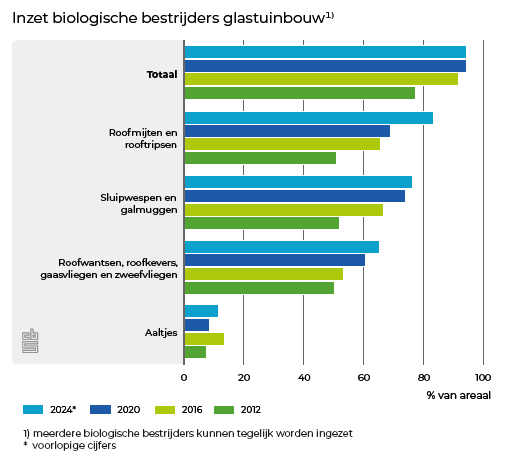
Jan erkent wel dat de omstandigheden lastig kunnen zijn. “Soms zijn er gewoon van nature veel schadelijke organismen aanwezig. Het is dan de uitdaging die tegen te houden. Je kunt in de kas insectengaas voor de ramen te plaatsen, planten veredelen die resistent zijn of planten zo sterk maken dat een plaag of ziekte minder kans Daarnaast wordt er al volop samengewerkt met de natuur door het inzetten van van biologische bestrijders (zie tabel). Zorg daarbij voor de juiste voeding, voldoende zuurstof en goede micro-organismen rondom de plantenwortel. En combineer dat met een optimaal klimaat rondom de bladeren zodat een plant goed kan groeien.”
Test at Plantion
Following questions from the market, we want it to be clear which substances are present on flowers and plants traded via Plantion. By providing this transparency, customers can make more informed choices when purchasing. We have asked Eurofins Agro to test a number of products. The results of these kinds of tests support the positive steps our suppliers are taking and can in the future give buyers the insight they need towards the consumer. It is a process in which many things are already going well and improvements are still needed. We are happy to give growers who distinguish themselves positively the stage and attention they deserve.
Biological control agents in greenhouse horticulture
According to Statistics Netherlands, in 2024 biological pest control agents were used on 94 percent of the total Dutch greenhouse horticulture area to combat pests. These mainly include predatory mites, predatory thrips, parasitic wasps and gall midges, as well as predatory bugs, flies and beetles.